"Women are the guardians of continuity. If the hearth moves, they move with it. Remember, it is the gypsy women who keep their men on the road."

~"Boomerang Love," Jimmy Buffett


Showing posts with label Argentina. Show all posts

Freedom to Fail: A Global Perspective

Recently, I submitted a video entry to the New Threats to Freedom scholarship competition, in response to Michael Goodwin’s “Freedom to Fail.” He claims that “entitlement mania” will foster dependence and complacency in the United States, a topic of great personal interest, since I recently lived in a leftist country that most Americans would describe as a welfare state.

I have described my campus life in Argentina as “UC Berkeley on amphetamines.” Banners and posters decrying capitalism and demanding revolution adorned the entire building. Classes were regularly canceled for indeterminable strikes and protests. Whenever we did hold class discussions, the students inevitably defaulted to the government’s failures to solve x-problem, whether it be air pollution, traffic accidents, or obesity. A blatant example of this complex was the family that calculated that it would be more profitable to produce more children and receive extra government assistance than to seek actual employment. Nonetheless, it is interesting that for all of the rampant “entitlement mania,” Argentina’s education system did not exhibit the social promotion that Goodwin describes in American schools. Unlike the US, their test culture remains rigorous and demanding. Failure is not only the norm, but expected. These stringent measures ensure that students who successfully complete their programs are not just proficient, but experts at their subjects. On the other hand, having an unlimited fully-subsidized education allows students to fail with relatively few reprisals, aside from the tedium of repeating courses year after year. With little incentives (or alternately, little consequences), it is not uncommon for “chronic students” to spend as many as 10 years completing their education, while producing minimal social output in the meantime.

Obviously, the US will not be adopting that type of mentality any time soon, nor should we. I would suggest, however, that we turn our sights towards burgeoning countries such as Singapore or South Korea whose values may be more in sync with the American Protestant ethic. Unlike your traditional “up-and-comers” China and India whose meteoric growth can be primarily attributed to industrialization, these countries are already developed. Currently, they are experiencing surging entrepreneurship and social enterprise, especially among young people. Whereas the economic crisis in the US has resulted in Goodwin’s alleged “flat earth,” these countries are thriving with new firms and innovation.

My theory is that a major factor is the existence of a robust public healthcare system that balances reasonable price controls with private practices and individual choice of providers. Limited social intervention does not necessarily have to be at odds with individual freedom, it can also reinforce it. This safety net (literal insurance) would grant citizens the freedom to fail at individual pursuits without failing their livelihood.  For this reason (and please take note of the many conditional modifiers to follow), I believe that an intelligent, restricted social infrastructure with a very focused scope could be effective in motivating people to take more risks. Nevertheless, putting these measures in place will by no means guarantee success, thereby keeping the freedom to fail intact.

My full response video can be seen below: 

Ask Jeeves - He Makes Dreams Come True

When I hearken back to my days as a mentor at TIP and my CELTA training in Costa Rica, I have fond memories of the ridiculous trainings and activities we used to do. As a 20-something college student, I have found myself doing icebreakers with toothpicks and fat smelly markers, building Macgyver-styled devices with rubberbands and legos, and reciting jazz chants to demonstrate past participle. Interestingly, one of the recurring themes that appeared at both jobs was the “criticism sandwich.” The general idea is that when you need to correct or critique a pupil, you should cushion the criticism between two pieces of positive encouragement to soften the blow. It would go something like this: You bring up a really good point. I’m not sure it’s the best solution, but you’re definitely not a complete idiot.

Get it? The ego-stroking is the “bread.” Cute, right? It sounds cheesy, and it makes the students sound like fragile, sensitive butterflies, but you wouldn’t believe what a successful strategy it was. I suppose it’s just human nature to like ending with a positive note, almost like closure. Well, if you scroll down a bit, you’ll see some traces of a Negative Nancy. Those of you know that know me well know that it’s just not my nature to be a complainer. In truth, it was always my intention to write a 3-part series about buses, and I was literally saving the best for last. I know I already shared my “good” experiences, but this trip wins in every category.

Interestingly, the best bus ride I took in Argentina happened to be the last one of our epic trip, and it mostly happened by chance. There were a combination of factors at play – both of us were slightly under the weather, we were emotionally drained, and we really didn’t have any desire to hang around the Buenos Aires station any longer than we needed to. Since it was such a high-volume station, there were frequent buses to Tucumán, and we just bought tickets for the next bus available. It just happened to be the first-class bus on Vosa, one of Argentina’s luxury fleets.

Wow.

I remember stepping onto the bus, and being greeted by a smiling young gentleman in a maroon vest, holding a small basket of mints and hard candies. He was going to be our attendant for the duration of the trip. I don’t remember his name, but I secretly wish it were Jeeves (linguistically implausible, because in Spanish, it would be pronounced ‘hee-vez’), because that’s exactly how bloody accommodating he was the entire ride.

Anyway, we headed to the upper floor as usual sank into our plush leather seats, and like little children testing out a new toy, immediately, we pulled the lever. We had no intention of actually sleeping right away, we just wanted to see what “class” our seats were. Fortunately, as an ejecutivo bus, all of the seats were the full cama, reclining back to an orgasmic 180º. Moreover, as the bus pulled out of the parking lot, we realized that there were less than 10 passengers on the top floor. It was going to be a good night. But it was still early, and we had several hours of reading, watching movies, and killing time before they would turn down the lights.

I shouldn’t have doubted, though, because Jeeves had everything covered. A couple hours into the ride, he pranced up the stairs, clapped his palms together, and gleefully asked if we were ready for dinner. Uhm… chyeah. I suppose on civilized buses, we must observe the formalities. He nodded as if to say, “Very good sir,” and proceeded to snap our tray tables into place -- the tray tables had attachments that connected them to the ends of the arm rests, creating tables, but essentially trapping us into our seats. As a young, 21st-century, independent-minded woman, I felt capable of matching Slot-A to Slot-B, but ever the gentleman, Jeeves insisted. It made me feel a like a baby in a high chair.

Selene hungry! Nom nom nom.
Absently, I wondered if they had any alternative arrangements for our more heavyset passengers, but then I remembered that we weren’t in the United States, and Kevin Smith wasn’t likely to take the Vosa bus.

Our meals were brought to us, vacuum wrapped per usual. Before we could get disappointed by the seemingly paltry portion-sizes of the servings (although they were still much better than any other bus fare we’d eaten), Jeeves was quick to inform us that these were just the appetizers. After we finished them, he brought out the hot meals which were wrapped in foil. There was something very satisfying about peeling off the foil and being bathed in steam. At that point, I was so impressed by the service, I would not have been surprised if they actually had a functioning oven somewhere in the galley. Next, it was time for drinks. In true unnecessarily cute fashion, Jeeves was carrying all the drink options in a wicker basket, as if picking your beverage from a basket was somehow classier. Aside from your typical fountain drink options (water, Sprite, Coca-cola, etc), there was also wine. Uh-oh, dilemma. The white wine would have complemented my entrée very well, but I wasn’t sure if the wine cost extra like it did on planes. Letting myself get wrapped up in the sheer spectacle of the entire experience thus far, I suddenly worried about making a social faux pas by asking whether it was free. To avoid any shameful acts of impropriety, I took the safe route and asked for a soda. In hindsight, I don’t know what I was so worried about… as if Jeeves would have cast me off the bus for asking a perfectly legitimate question. I’m not even sure who I was worried about judging, since there were only 4 other people within earshot – one of whom was my roommate, and the other 3 were French students who didn’t understand Spanish. At any rate, I allowed myself to indulge in my silly Austenite melodrama. That is, until I heard one of the French students behind me utter one of the few Spanish words she knew: vino. Chancing a glance behind me, I saw Jeeves graciously pour while the girl giggled. There was no exchange of currency, no transaction. Damn. It was like that episode of Family Guy where Peter ordered a salad, but really wanted soup. “But it was too late.”

With the timing of a competent waiter, after we all had an appropriate amount of time to nosh on our dinners but before we had cleared our plates, Jeeves came by again with his magical basket to ask if we wanted a refill. Gasp. Did I dare? Switch beverages? I decided to press my luck. I was feeling trepidation, but I played it cool and asked if I could try the wine. Jeeves didn’t even blink as he happily poured me a new cup. Success! Incidentally, the wine tasted awful, but I was in such a good mood at that point, I didn’t care. When he came around a second time, I had another one. It helped make the movie we were watching, a dubbed version of “Leap Year,” seem much more touching and well-acted than it probably was.

As to be expected, the pacing and service of this ride was impeccable. I’m fairly certain Jeeves came up and down the aisle a couple more times with more drink refills, but I had to turn him down. After dessert (yes, there was dessert!) they turned down the lights, but for those of us that weren’t quite ready for sleep, they had the courtesy to put on another movie, “I Now Pronounce You Chuck and Larry.” The cheap wine could not have been more appreciated.

As the credits started to roll, I think most of us were ready to turn in for the night. Ever the attentive innkeeper, Jeeves made one last run-through of the aisles. I assumed he was checking on the blanket/pillow situation, so imagine my surprise when he asked, “Whiskey?” Come again? The confusion must have shown on my face, because Jeeves resorted to pantomime, throwing his head back as if sipping a shot. Seriously? A nightcap? They were really offering me free liquor. I have never felt more bourgie. I felt like I needed a maroon smoking jacket to go with my brandy. It was one of those rags-to-riches “Pretty Woman” moments where I didn’t know what to do with the escargot pliers. It was like the first time I was in a European hotel and saw a bidet. I felt so undeservedly privileged, that I was too embarrassed to accept. That’s right. I was shamed into turning down free booze. I went to sleep feeling slightly dirty… both because I was being treated like a character in a Fitzgerald novel and also because it had probably been a couple days since our last shower. But the pillows were so damn comfortable and squishy that it didn’t make a difference.

The next morning, Jeeves was up bright and early. Like a doting mother, he wanted to make sure we were up and at ‘em, since we were nearing our destination. To gently wake us up, he offered us our hot, steaming caffeinated beverage of choice. It was just like a Folger’s commercial. Sure enough, shortly afterward, there was breakfast. Yes, it was an Argentinean breakfast, but the thought was nice. And either way, we were getting close to Tucumán. And as we rolled onto the platform, Jeeves gave us a little gift box full of treats to send us off.

It hung on our wall for the rest of the year.

Night at the Bus Station: The Battle for Floorspace

When it comes to travel writing and blogging, the focus is almost exclusively dedicated to what you find at the destination. And rightly so – that’s sort of the point of traveling, right? Occasionally, there might be some spotlight on the method of travel itself, such as my last post highlighting some of my more memorable experiences on bussing around the country. What is usually neglected, however, are those interim periods between stops. I mentioned in my last post that I have amassed over 150 hours of bus travel. That figure does not include the countless hours of wait time spent dawdling between stops.

In a perfect world, one would arrive a comfortable 15 minutes prior to their departure time, just enough cushion to check their luggage, buy a snack, and use the bathroom one last time, but not so long that you feel you are wasting time by being early. The bus ride would be uneventful, and upon arrival at the target destination, one could immediately board the next taxi to the destination city’s center and the fantastic travel adventures would commence.  The amount of time spent at the actual bus station would be minimal, a parenthetical that is so fleeting that it doesn’t really dignify acknowledgment. Sadly, that is rarely the case. Whether it was due to mechanical problems, layovers between bus rides, union strikes, or just inexplicable delays, a good, not insignificant chunk of our trip was spent hanging out in bus stations. Although it isn’t particularly glamorous or romantic, considering how much time we have spent in bus stations, I felt it would be remiss to ignore this inevitable aspect of our travels.

You see, when travelling by bus, every small decision can affect your experience: the bus company you select, the time of year, the time of day, and even the seat number. Over the last several months, I like to think that I have become quite savvy at striking that balance between minimizing my travel time, maximizing my comfort, and keeping within my budget. The bus station itself, however, is a factor that you have relatively little control over. In my experience, bus stations have run the gamut from ramshackle benches and dirt floors to full-service centers that rival most outlet shopping malls. Interestingly, although the bus station is technically your first impression of a new location, there is rarely any correlation between the bus station and the actual city. For example, Buenos Aires, for all its glitzy, cosmopolitan glamour, has a bus station that is as skeezy and unattractive as the rest of them. The basement flower felt like the catacombs of Snape’s dungeon, the concrete walls and floors were uninviting and cold, and the open doors allowed for the occasional stray dog or beggar child to wander freely. Meanwhile, random unassuming cities tucked in the middle of nowhere like Neuquen have inexplicably clean, immaculately kept stations that provide a pleasant surprise for travelers who have the privilege of passing through to use their facilities. 

Perhaps the only features accurately represented by the station are the city’s size and popularity among travelers.  To begin, Buenos Aires’ massive tri-level station has an elaborate color-coded system of dividing gates and ticket agents by regional sectors based on the destination. For example, if you were bound for Tucumán, you would head towards the “Northwest Argentina” zone (orange, I believe), which is then subdivided according to different bus companies. This system is further complicated during off-peak hours, when you arrive at your target location, only to find a sign taped to the window directing you to a sister counter in another zone. It’s not unlike arriving at your gate at the airport, only to find that the waiting area for your flight has been moved to the terminal on the other side—the only difference being that none of the bus stations have the handy golf cart drivers, moving floors, or underground shuttle systems that can expedite the commute. About the closest thing I have encountered to that level of technological convenience is that Cordoba, Argentina’s next largest city, has escalators connecting some of its floors (but just some of them). This behemoth station is a four-story monstrosity with a labyrinthine design that does little to facilitate its high traffic. Instead, I found myself in a maddening cycle of crossing bridges, going up and down stairs, following arrows, and essentially finding myself back where I started – it felt like being in a living Escher painting. This mayhem is compounded by the fact that despite its size, there is very little diversity among the sectors. It’s an endless cycle of the exact same cafes and restaurants with the exact same signs, with waiters wearing the exact same uniforms, serving the exact same food. Needless to say, after hours of travelling and sleep deprivation, it is easy to get disoriented.

Cordoba's station is like a less Inception-y version of this 
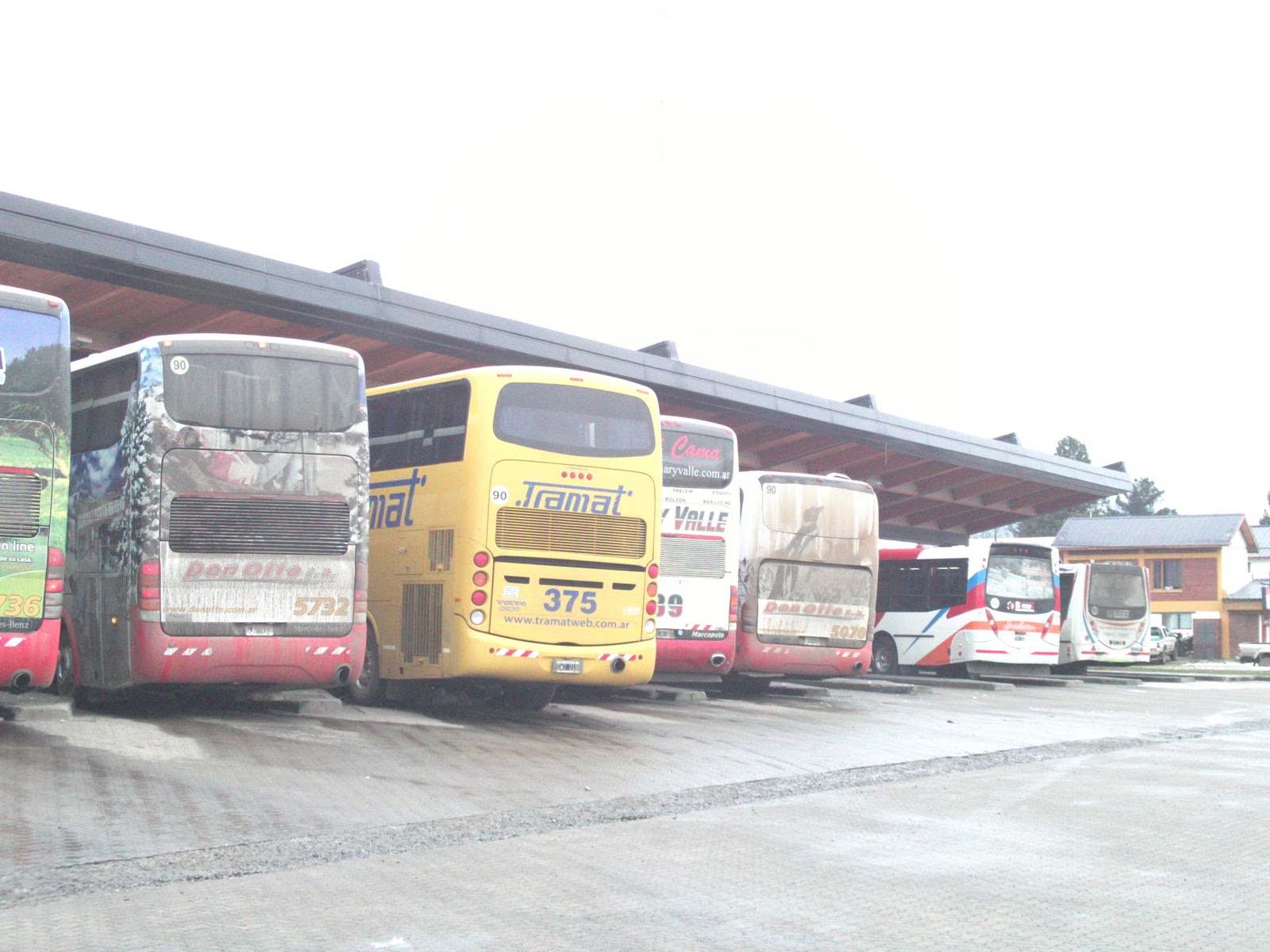
Meanwhile, on the other side of the spectrum, you have the cities that are too small to justify a central bus terminal. Usually there are only a handful of bus companies that pass through, so they will drop you off directly at their ticketing station. There is rarely a waiting area or information desk (or bathroom!), so you’re on your own as far as finding your way into the city, getting food, finding housing, etc. Some of the routes which primarily serve locals go one step further. Rather than having an actual building which serves as a station, there is just a desultory bench or decrepit little tin structure on the side of the road. Occasionally, I have seen passengers who flag down the bus from places on the highway which are completely unmarked. I have yet to figure out what establishes these locations as actual “stops,” and fortunately, I have never been put in the situation to find out.

El Bolson bus "station" 
As hinted at before, however, due to the freak cold snap that swept through Argentina in July, I was forced to spend my first night at a bus station.  The irony of the story, however, is that we didn’t technically have to sleep there. All the buses for that night were suspended, that fact wasn’t changing. What surprised me, however, was that the bus companies and conductors were generously offering passengers the chance to sleep on the heated bus. Seeing as how the initial plan was to take an overnight bus anyway (not to mention that we were already experts at the fine art of bus-dozing), that offer did not seem like an altogether awful compromise.  It was actually much better than expected, and we had every intention of accepting this plan.
We just wanted to eat dinner first. And again, wonders never cease, the bus companies were providing hot meals for all the passengers who were stranded at the station. Most of the passengers were just eating on the bus, but having just freshly arrived from an earlier bus, we decided to stretch our legs and make ourselves comfortable in the station's restobar. July 19th was el Día de los Amigos (seriously, any excuse for a holiday here), and we thought that our companionship was worth celebrating. Plus, we just really wanted a drink. So we thought a bottle of beer and a little dessert would be a fine accompaniment to our respectable little TV dinner of stir-fried rice.
Our Friendship Dinner
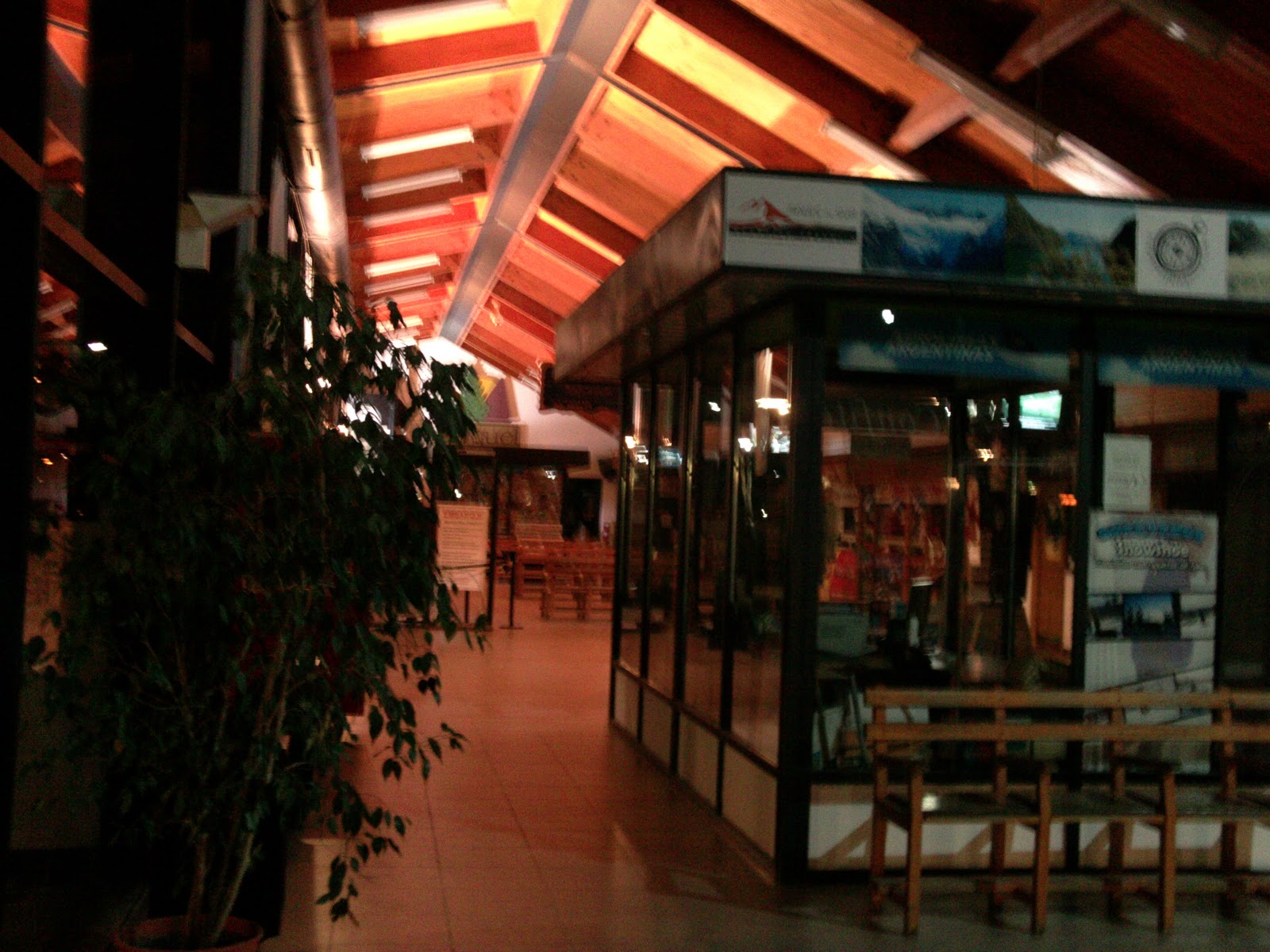
If I had the choice to pick a city in Argentina to be stuck in for the night, Esquel (population 28,000) would not have been at the top of my list. This observation is based on the fact that aside from the casino down the street, the restaurant in the bus station bar may have been one of the more happening places to be. The café was a fairly large room, complete with a projector screen, audio equipment, tacky Christmas lights, and a chalkboard that promised live music on Thursdays (alas it was a Monday). Nevertheless, the atmosphere was much upbeat than your average bus station, and infinitely better than being stuck in a bus full of sleeping babies. Initially, the plan was to strategically exhaust ourselves in order to pass out on the bus. It was working splendidly - we were laughing and enjoying eachother’s company, we were well-fed and in high-spirits, plus we had the luxury of using a normal-sized bathroom whenever we wanted. At about 2:30 AM we finally decide to turn in for the night and head to our bus. It was then that realized that we had been locked out. What we hadn’t considered was that it was only the passengers who would be sleeping on the bus-- not the drivers. Miscalculation. The other passengers couldn’t have let us in if they wanted to. With no other options, we headed back to the station, picked a spot away from the windows, spread our blanket on the floor, put on as many layers as possible, secured our backpacks to a nearby bench,  and lay down for some fitful, chilly sleep. 
We spent the night under that bench
All things considered, we made the best of a bad situation, and truth be told, it could have been much, much worse. Although neighboring cities like Bariloche and El Bolson had more going for them touristically, their open air bus stations would have forced us to find hostels for the night. That said, sleeping on the floor of a bus station (even one with a roof and doors) is just another of those romantic, rugged, thrilling backpacker fantasies that gets you some marginal street cred among other travelers. Once you cross it off your bucket list, though, you never really have a desire to repeat it. 

Planes, Trains, and Automobiles: Bussing it throughout Argentina

As promised, after logging over 150 hours of bus travel (and counting!), I can comfortably say that I’ve become an expert at bussing through Argentina.  I have experienced every level of “bus,” which has become a fluid term, since it includes everything from a modest 10-seater van which took us from Rio Gallegos to El Calafate to the Marga bus which ended up boarding a ferry to cross the Strait of Magellan:


As I started writing, I quickly realized that the variety and breadth of these experiences could not be encapsulated in just one post. As such, I'm taking a page from my food post, and splitting this entry into a three-part series (sort of like a Horcrux, only not the consummation of all that is evil and unholy). Over the next few days, I hope to shed some insight on one of the most fundamental aspects of traveling in Argentina, while hopefully dropping some amusing anecdotes along the way. 

Part 1: The Good, the Bad, and the Ugly

When the buses are good, they’re awesome.  When they’re bad, they can be miserable. Anybody who's traveled knows that the smallest complications (delays, feeling under the weather, forgetting your camera, etc) can affect your perception of the company, and it can often difficult to separate those issues from a genuinely bad experience with the busline/airline/travel agency itself. Nevertheless, I have endeavored break it down as objectively and honestly as possible. 

Food
  • Good: A standard long-distance bus ride with servicios usually provides food at the appropriate mealtime. Some bus companies have provided pretty solid offerings, including a protein entrée, a side of bread or rice, dessert, and occasionally a beverage. If the bus times don't necessarily fall during mealtime, they may still offer a snack box or drink. 
  • Bad: Some cheaper companies settle for really stale vacuum-packed ham and cheese sandwiches on processed white bread which just leave you thirstier than when you left. 
  • Ugly: It can often be unpredictable in what situations they will serve food. The very same company that served some of the best bus food I have eaten also left us starving on the 14 hour ride from Trelew to Rio Gallegos. Foolishly, with each passing bus stop, we refrained from purchasing a snack because we thought to ourselves, “Surely they must feed us soon.” Silly us.


Buses 
  • Good: Interestingly, the seats are classified by angle of recline. The standard “economy” seat is a semi-cama (semi-bed), which reclines so the passenger can sleep in a semi-prone position. I have never really experienced problems sleeping in this position, but then again, I’m short enough to fit in the seat. If you are willing to spend a few extra pesos (I’m talking roughly the equivalent of $5USD), you may get a full cama which unfolds into a completely horizontal position. In this regard, an executive or first class bus is luxury when it comes to leg room, comfort, and cushiness. An advantage to the cheap seats is that they are on the top tier of the buses.  If you buy your tickets in advance, there's a good chance you can get a front seat with a little extra leg room and a fantastic view. 


Front row seats
  • Bad: The complete disregard for any semblance temperature control. In the summer, the buses are almost always about 10º too cold, resulting in my wearing a laughable number of layers for a tropical climate.
    Entirely too many layers for a visit to Iguazu in May
  • Ugly: During my first long distance ride to Resistencia (about 12 hours from Tucumán), it was uncharacteristically rainy throughout the entire country, and it rained the entire ride. It was as if a storm cloud was following me all the way to my next destination. Since I wasn't driving,  this would normally be a minor inconvenience at most, if not for the small problem of the leaking ceiling dripping cold rain water over my head.


Entertainment
  • Good: Some rides are timed remarkably well, so there are very few moments of idle dead time where you’re staring blankly out the window or sleeping for lack of anything else to do. During these rides, the conductor keeps a steady cycle of meals, movies, and the occasional game of bus bingo to keep our circadian rhythms as normal as humanly possible. In particular, some of the bus rides have showed some very high quality boot-legged movies, including blockbusters like “Sherlock Holmes” and Academy Award winners like “Hurt Locker” and "Blind Side." 
  • Bad: If the conductor can’t be bothered to turn on the DVD player, they will turn off the lights at 8PM and expect you to sleep until morning. 
  • Ugly: Some of the awful straight-to-DVD movies that they wouldn’t even bother releasing in the US, normally starring either Rob Schneider or Michael Jai White. 


Bus Stops
  • Good: Long-distance buses usually make several stops along the route. On an overnight bus, a considerate bus line might turn on the lights when they approach a major bus station, so people who will be disembarking know to wake up and start gathering their belongings. A particularly attentive conductor may even announce the stop for people too disoriented and groggy to notice their surroundings. An exceptional conductor will announce exactly how many minutes the bus will hang out in case you need to make a bathroom or snack run. 
  • Bad: Not knowing which stop you are at (bus stations are often unmarked), and out of fear of missing your stop, being forced you to stay awake for several hours, straining to catch a kilometer marker or some city sign to orient yourself. 
  • Ugly: Not knowing whether the bus is stopping for a break, to refuel, or to drop somebody off and being so paranoid about being left behind, that you end up holding and waiting when you really, really, need to use the bathroom.


Scheduling
  • Good: A bus originating from your destination, so it departs on time and arrives relatively close to the ETA (approximately within 15 or 30 minutes). 
  • Bad: Mechanical or electrical problems that cause you to be stuck in the Resistencia bus station for 3 hours, after only having traveled 17 kilometers. 
  • Ugly: A 24-hour transportation strike on the day you were originally planning to travel from San Juan to Bariloche: the longest leg of your journey (approximately 16 hours)in which you had bought the tickets a week in advance in anticipation of high season.  
A noble fleet of buses

Rock 'n Roll Part II: How to Live Out of a Backpack for a Month

Several months ago, I described the systematic purging of my belongings in order to both meet the baggage requirements and pack for 9 months in a foreign country. It was a surgical process that took place over a series of several days. Recently, I had the opportunity to take a month to work my way down the Southern cone, bringing me all the way down to the southernmost point of the planet. Considering this journey’s extreme level of epic-ness, the packing process could not have been any more different or haphazard. I suppose all these Latin siestas are beginning to rub off on me. Confident in our abilities to speedily stuff a backpack, Selene and I put off packing and shopping for our trip until the day of our departure. Specifically, we waited until a few hours before our bus left to purchase any last minute items. Nothing important, just… you know… coats and stuff.

In March, the biggest challenge was predicting the range of climate extremes that I might face throughout the year, and trying to be prepared for every situation. This time, we knew exactly what type of weather we would be facing: cold. We were on a fool’s errand to head to Antarctica in the dead of winter. We would be facing the elements – mountains, wind, snow, and possibly elephant seals. No, we knew what we were up against. The challenge here was figuring out the most efficient way to pack bulky winter clothes in order to meet the dual goals of offsetting crippling hypothermia while also keeping everything under one backpack. Having spent the last 6 winters in Austin, the most extreme cold I had to deal with were the trips between my car and indoor central heating. As such, I have always been a big proponent of wearing several thin, removable layers, as opposed to one or two genuinely warm ones. It was my hope that this system wouldn’t fail me now.

Keeping in mind that Argentina isn’t necessarily renowned for its high-quality textile industry (every item of clothing I have purchased in this country has unraveled, faded, torn or otherwise failed me. In fact, I had to devote a day in Uruguay to sewing and mending a pile of clothing so high that it could have inspired an animated Disney princess song), and that buying actual Northface or Patagonia wintergear would literally cost me a month’s rent, I had to be strategic in selecting my clothing. I adopted a formulaic template for layers which I followed throughout the duration of the trip: a thin tank top, a thin long-sleeved undershirt, a top t-shirt, [optional additional sweater or jacket], and overcoat. The bottom half was even simpler: shorts or leggings under a thicker pair of pants. None of these items were particularly high quality – most of my shirts were purchased at outlet malls and most of the pants were purchased at either Old Navy or Wal-mart (yes, I know, the child labor unions are crying). The Argentine coats and hats were purchased at flea markets, and it was doubtful that they would last beyond the duration of the trip. In fact, it is possible that the most valuable (and probably highest quality) items were the Longhorn memorabilia I brought for the express purpose of photographing myself flashing the horns in exotic locations.


The logic was that a firm foundation of thin, tight-fitting underclothes would provide sufficient insulation to retain heat from the subsequent layers which would otherwise be completely inadequate to provide any actual warmth. It was the theory that the whole would be stronger than the sum of its parts, or some other syllogism which may or may not have any solid grounding in the laws of physics. Either way, I was banking on this strategy to protect me from the severest cold that my poor Texas soul had ever faced. To my relief, it worked out beautifully. On days we spent outdoors, we either had the good fortune of direct sunlight or just made sure to move at a fast enough clip to keep our core temperature elevated.

So now that I have established that a few discount t-shirts actually can brave the cold of Ushuaia, allow me to explain the actual packing process. This method works so easily, you have to make an active, deliberate effort to mess it up. I was lucky in that I had a solid backpack that lent itself to intuitive, no-brainer packing. Pretty much, I packed inside out: burying the most valuable items tightly and deeply, progressively expanding out with more expendable items.
  1. Super-secret pocket: This goes back to knowing the anatomy of your luggage. But as with my suitcases, my backpack had an interior zipper that opened up to the skeleton of the pack. I tied the pouch with my passport, money, credit cards, and keys to the internal frame and kept them hidden away for most of the trip. The only way somebody was going to reach them would be to steal the entire backpack, which wasn't going to happen on my watch.


  2. Main compartments: Again, I packed my clothing in accordance with the Rolling Method. The main difference this time was that instead of dividing them into bundles according to type (ie, a tank top pile, a t-shirt pile, etc), I made sure that each “roll” contained a couple types of each item. In accordance with my “no outfit rule,” I tried to pick articles that were essentially interchangeable. Theoretically, I could randomly peel a couple layers from the pack, throw them on, and walk out the door without looking like a complete hot mess. At most, it would’ve been an endearing level of dorky, semi-fashion forward tackiness.


    As a sidenote, I should mention that in matching (or mismatching) my clothing this way, I had stumbled upon a system which ensured a steady stream of clothing that would be recycled for the duration of the trip. In the traditional school of unwashed backpacker thought, you should stick with a single article of clothing and continue wearing it as long as your personal sense of hygiene and dignity will allow you to “rough it” so comfortably. For whatever reason, I decided to defy logic and experiment with changing my clothes on a daily basis like normal. Rather than keeping a stock of valuable fresh clothes and a few truly filthy pieces of clothing, I decided to split the difference and keep a steady supply of lightly worn, possibly slightly dirty, but generally wearable clothing at all times. Admittedly, there was a psychological motive – by constantly rotating out my clothes, I had a hard time keeping track how many times I’d worn each item, probably psyching myself out on how dirty they actually were. This stroke of Ender Wiggins-style backwards brilliance resulted in an almost foolproof method for dressing myself. As an added bonus, by constantly cycling through my clothing, I never had to deal with a bulky laundry bag of dirtied clothes taking up space in my pack.
  3. Fill in the blanks:After rolling up the primary pieces of clothing, I indiscriminately filled up the empty spaces with amorphous, squishable items (socks, bras, paperback novels, etc). If possible, you want to create a snug fit to keep things from moving around, but loosely enough that things can be shuffled around if you need to add to your pack. You never want it to be so full that you’re forced to stuff, since that almost always guarantees that something will be lost or misplaced.

  4. Outside pockets (side, front):Pretty much, these compartments were filled with trivial little items that I had no qualms parting with: toiletries, pens, postcards, dirty underwear. Although, I had no intention of leaving my bag unsupervised, if somebody were to sneak into the compartments, the insecure outside pockets would make for the easiest access. Really, coupling my level of robbery paranoia with a seemingly contradictory tendency to lose and spill things, it was just as probable that these things would have fallen out of pure carelessness, which is another reason I didn’t keep anything irreplaceable on the outside.


The end result: After just a couple days of traveling, I had nailed down the system of rolling and stuffing that I could unload and re-pack the entire thing in 5 minutes, including the souvenirs that accumulated along the way. Aside from occasionally having to handwash my panties at night, I only had to do one load of laundry in the entire 4 weeks. And besides an occasional sniffly nose from being outdoors for extended periods, I managed to make it through the whole trip with my immune system intact. To pull a Colbert, I think I can declare my mission to backpack to the end of the world a “capital V” Victory. Tierra del Fuego: owned.

It's Raining Ash... Hallelujah? Springtime in the Garden State of Argentina

When I initially received my assignment from Fulbright, I had never heard of Tucumán. As any self-respecting millennial would do, I immediately set out to snoop around with my Googling and Wikipedia-ing skills. The information available was scanty, but the nickname that kept popping up was El Jardín de la República ("The Garden of the Republic").  My first reaction? “Great, I’m going to live in the Jersey of Argentina.” To be fair, I have never been to New Jersey, but through various media outlets, I have gathered that it is the punchline of almost all New York jokes, and there is an explicable infatuation with jagerbombs, housewives, Zach Braff, and people with epithets like "Snooky" and “The Situation.” As yet, I have yet to see any references to actual gardening.

It was the same… ahem… situation when I initially arrived in the province. Apart from the green hills of Yerba Buena and San Javier nearby, there did not seem to be much in the way of flora or exceptional produce. Although it took nearly 6 months, Tucumán, at least, is finally beginning to live up to its nickname. Spring is in the air – birds are chirping, the days are longerl the stores are liquidating their winter collections; huge, plump strawberries are being sold by the kilo; and perhaps most notably, the flowers are in bloom.  Suddenly, the city has erupted in a burst of bright yellows, pinks, and oranges. Naturally, being from the Northern hemisphere (they refer to all Americans as yanquis, regardless of their actual home state), I mentally categorize these hues as “Easter colors,” despite the fact that it is September.  Some of the streets are lined with rows and rows of lapacho trees, creating an endless stretch of pink, which delights the girly girl deep inside of me (very deep). The end result is magnificent.


Additionally, in a stroke of administrative genius (rare in these parts), somebody had the brilliant idea to plant orange trees around the city. The oranges themselves are inedible, so my theory is that they were planted for the express purpose of providing citizens with enjoyment when the azahares (orange blossoms) bloom in the spring. These creamy white flowers emit the most intoxicating, mouthwatering scent – its’ like vanilla mixed with jasmine mixed with honey, and a hit of citrus. It’s romantic and sexy and spicy all at the same time. Every time I chance to stroll underneath its branches (which is easy for me, because I’m short), I close my eyes and inhale deeply.


So it’s probably no wonder that I have been hacking up a dry storm at night for the last couple weeks. You see, in addition to being the season for pretty flowers, pleasant outdoor constitutionals, and holding hands, spring is also the time that farmers prepare their sugarcane for harvesting. Tucumán is actually one of the largest producers of sugarcane in the world. So what is the fastest, most efficient way of processing large quantities of it? Why, burning acres and acres of field, of course.  As a result, even on the sunniest days, there is an unpleasant grey haze of dust and smoke that lingers in the air (I guess the Jersey metaphor goes both ways).
That's not precipitation or fog. That's smoke. 
On windy days, the particles in the air are painful to the point that people wear sunglasses and scarves to protect their eyes. On calmer days, the debris settles on the ground, sidewalks, windows, and cars creating an oppressive film of dust on every flat surface. It has become such a hazard that Weather.com sometimes lists the Tucumán forecast as “smoke.”
 An actual screenshot of a Tucumán weather forecast. 
As luck would have it, my body seems particularly sensitive to these climactic abnormalities.  There have been several nights where I’ve been racked with a violent dry cough that keeps me from falling back asleep. Some mornings, I wake up too congested to breathe comfortably, or I have a sore throat that results in my speaking in a husky, drag queen type voice. At first, I was worried that these symptoms might be indicators of a chronic cold or something, but without fail, they subside as the day goes on. It really is just worst at night and in the morning. As a by-product of trying to determine the initial cause, however, I have stumbled upon some consistent patterns that have proven to be reliable predictors of the weather. For example, congestion usually means a drop in pressure, likely indicating rain or a cold front coming.  Coughing means that I should prepare myself for a particularly intense day of smoke or dust, while sniffles just mean that there is crap in the air, but it will still be sunny and pleasant outside. It’s almost as if my overactive immune system has developed  Wolverine-like heightened senses.  So while it’s unfortunate that my last couple of months in Tucumán will be plagued with unpleasant side effects, my fantasy of having a mutant superpower has finally been fulfilled. It’s not nearly as glamorous as I would have hoped.

The Andes: So Much More than a Chocolatey Mint Thin

It´s a popular urban legend that Eskimos have a ridiculous number of words for snow. I am pretty sure that this myth was debunked in my Intro to Linguistics class, but the general idea is that cultures craft their language around what is important to them. Living in Texas, I never had a pressing need to develop a nuanced snow vocabulary. I have, however, attached certain connotations and feelings with it. For example, I have always been infatuated with kitschy snowmen and penguins during the wintertime - the campier and higher the likelihood that it makes it onto an ugly sweater the better. These guys remind me of Christmas, which is my favorite time of the year.
Another image that appears in my mind´s eye is that of a picturesque alpine lodge nestled in the mountains. I see a European style villa where you can curl up by the fireplace on a cozy bear rug sipping a mug of hot chocolate after a day of skiing. Resort towns like Aspen, Switzerland, and even Bariloche elicit an element of luxury and bourgeois privilege.

Finally, less often, I visualize a scene of kids riding a makeshift sled or skating on a frozen pond. Usually these pictures of childhood innocence are faded and grainy, in the style of a Norman Rockwell painting or Charlie Brown.

These are my sort of happy place idyllic connections with snow. I turn to them because they are comforting and pleasant. The reality, though, is that there is an entirely different side which I recently experienced firsthand in Patagonia. It started on a busride from Bariloche to the little hidden town of El Bolson, where we wanted to spend a few hours before taking an overnight bus to our next destination. To maximize our time in El Bolson, we left Bariloche on an early bus.

We were ready. The bags were packed and the clothes laid out the night before. After whipping up a quick breakfast and downing a morning tea, we were loaded onto the bus before 8AM. The sky was pitch black, and we were hoping to catch an Argentine sunrise. As we rolled out of the station, there were just three people on the bus, and I wondered whether the company was losing money on the trip. As it turns out, there were a number of smaller stops throughout the city, and we picked up some more commuters along the way. Once we were up to 12 or so, the bus driver turned off the lights and invariably, like obedient little Pavlovian dogs, we fell immediately asleep. As I place it, it was probably around 8:30 at that point. I remember merging onto a highway before drifting off. I woke up at approximately 9:20. Wow. What a difference and hour can make. White. To my complete shock, we were now rumbling through what appeared to be a blizzard in the arctic tundra. We were surrounded by trees and mountains to both sides. Everything was covered in a blanket of stark white, including the sky which had taken upon a nondescript milky, canvas color. No sun, no clouds. It was as if this sheet of white never ended.

Folks, this was not a winter wonderland. This was Mother Nature on steroids, and she was flexing. The forest was rendered unrecognizable underneath a coat of thick snow. Branches protruding from long dead trees were crystallized in ice, forming bizarre glassy sculptures. For miles and miles, there was no trace of life or civilization - no vehicles coming or going, no birds circling, not even the occasional flora to provide a little color. We were staring complete desolation in the face. The monochromatic scene was not quite beautiful, but nevertheless awe-inspiring in a hypnotic, terrifying way.

The snow that was falling outside the windows was not soft and powdery. It did not want you to make paper cutouts of its unique star-shaped snowflakes. It was not here to provide a playground for your winter sports entertainment. This was pellet-shaped, no-nonsense, "I will wreck your shit" snow. Think "Fellowship of the Ring" and the Misty Mountains. If the bus broke down, we would have been as helpless as Merry and Pippin (I´ll let you guys guess which one of us was which). This snow meant business.

For this reason, I sat with baited breath as the driver masterfully wove us through the switchbacks of the Andes. I watched in silence, transfixed, for about 20 minutes or so when all of a sudden, the entire scene just stopped as abruptly as it started. All of a sudden, there was color again: evergreens living up to their name, there were even occasional clumps of bright red berries popping against the shrubbery. It was like a scene from "Pleasantville." The snow was still falling, but not strongly enough to stick. As we exited the mountain pass, the first signs of civilization were these quaint little wooden cabins worthy of a St. Jude Christmas card. Between the smoking chimney, the cake icing-like snow frosting their roofs, and the clothes drying out in the backyard, the scene was downright cute. It would have been easy to be lulled into a false sense of security, but I wasn´t going to be fooled so quickly. After witnessing its capabilities, I knew the snow would turn on us at any given minute.

Sure enough, I started writing this post from the cafe of Esquel bus station, where we got stuck spending the night, hobo style, on the floor. The reason? Snow blocking the roads to Trelew.

World Cup 2010: Vamos, Vamos, Argentina!

On the 3-hour return flight from Ushuaia, LAN airlines made the genius, inspired decision to show a game-by-game recap of the 2010 World Cup finals. Eager for a distraction from the little girl who would not stop kicking the back of my chair, I plugged in my headphones to watch. To my amusement, it was a British sportscaster narrating the game recaps. It was delightful to hear his Anglophile renditions of names like “Xavi,” “Forlan,” and “Kaka.” To my horror, with each passing moment, I came to realize how fully I had invested myself into this sporting event. For starters, I had somehow found the time to watch every game in the knockout stage. Moreover, I hadn’t just watched them. I followed them. Religiously. I recognized the names of the star players (usually the “strikers”). Every night, I would faithfully log on to ESPN to filled out the results in my little bracket chart. From the highlight reel, I was able to relive some of the emotional highs and lows: My heart swelled with pride when Donovan scored the last minute go-ahead goal to push Team USA into the finals. It broke for Ghana’s overtime loss to Uruguay. I cringed as I was forced to re-watch Germany’s systematic disassembly of my beloved Argentina. And in the dramatic finale, when the camera zoomed in on Iker Casillas, the Spanish captain and goalie, weeping for joy at his country’s first title, I found myself shedding a tear for them as well.

It seems like only yesterday that in anticipation for this grant, I was asking my friends for a crash course on the rules of the game. The concept of “offsides” was particularly difficult to grasp. I remember being at a restaurant with Koci, who was moving salt shakers and napkin holders around the table. With Zack, we were at a tattoo parlor, so the only props available were his hands. Although their valiant efforts were unsuccessful, it all turned out to be unnecessary. As it turns out, I just needed to watch a couple actual soccer games. Once the Mundial started, it all clicked. By the end of the qualifying rounds, my Facebook status was dominated by shout-outs to Palermo and Maradona. Selene and I were fluently dissecting the different styles of play: Team Argentina’s flashy offense, Germany’s chilling scoring-efficiency, Spain’s intricate European formations, Team USA's clumsy ball-handling, Holland... just kind of being there. One of my prouder moments was maintaining a respectable conversation with a middle-aged Argentine banker regarding the differences between the European and Latin leagues. It is for all these reasons that I am convinced that the World Cup remains the single-most international sporting event, even surpassing the Olympic Games.

For example, I have found K'naan's stupidly catchy “Wavin’ Flag” song far more effective at rallying a crowd than any of Bono’s or Will.i.am’s UNICEF/Save the children/USO super-medleys. Just last week, the kickboxing instructor at our gym made us do about 30 lunges to this tune. I don't care how cheesy it is- even now, 3 months after the start of the tournament, the opening “Ooh-oh-oh-oh” riff still gets my blood pumping. There are several versions recorded to appeal to the various regional demographics (for a fascinating examination of Middle Eastern culture, check out the Arabic version featuring Nancy Ajram), but naturally I am partial to the Spanish version featuring David Bisbal:


One of my favorite memories of this season (and possibly my entire stay in Argentina) was the Argentina vs. South Korea game on June 17. Purely by chance, this game fell on the week of the Fulbright midterm conference, and we all found ourselves back in Buenos Aires. It was a double whammy-- not only was I reunited with my fellow ETAs, but we also had the unique opportunity to watch a World Cup game in the capital city. It was sure to be a memorable experience, possibly the only thing that would have roused some of us up before 8 AM. Meeting in the lobby, we were decked out in our various iterations of celeste and white: silly hats, bootlegged black market imitation jerseys, one particularly enthusiastic individual had draped himself in the Argentine flag.

Gringos united
We were headed to the Plaza San Martin in the heart of Retiro, one of Buenos Aires’ largest and most centrally-located districts. The expansive park features a sprawling, sloping lawn, perfect for an outdoor showing. Cold and still bleary-eyed from shenanigans the night before, we shuffled in silence. The streets around our hotel were fairly empty, or at least only just beginning to wake up. As we neared the plaza, however, the undeniable buzz of a gathering crowd became palpable. Our pace quickened as we followed the electric hum of people convening from all directions. Street vendors with horns, flags, and other miscellaneous memorabilia were beginning to pop up with increasing frequency. We started to see more wires and cords, eventually leading to A/V equipment. And finally, we saw the huge screen and knew we were in the right place.


Our party situated itself near an enthusiastic-looking group (per K'naan's instructions, there were lots of flags waving) - close enough to get a great view of the action, but safely out of reach from potential mosh pits up front. It turned out to be a good decision, since hidden amongst our neighbors was a little impromptu band featuring a drummer and an indefatigable trumpet player whose tunes kept us hopping and clapping the entire game.

And what a game it was. With each Argentine goal (there were 4… it was kind of a slaughter), the crowd reaction grew increasingly raucous and rowdy. By the third goal, we were hugging, screaming, and twirling our shirts over our head. Confetti was raining, and those horribly obnoxious horns that sounded like dying elephants were blaring non-stop. By the end of the game, our throats were hoarse from cheering, our feet were tired from jumping, and our shoulders were sore from waving our arms. It’s one of the best feelings in the world. It’s like that adrenaline high that you feel after leaving a rock concert or a really badass nightclub. Everything is little muted because your ears are ringing, but you really don’t care because you’re in such a giddy mood. Nobody’s really talking to eachother, but there’s a little skip in everybody’s step as you’re walking back home (or in this case the hotel). Even in typing this entry, I am just hit by a wave of nostalgia for Texas football games at Darrell K. Royal Stadium… the Godzilla-tron, the incessant drum cadences, surprise appearances by Matthew McConaughey, and those coupons for 5 free wings at Plucker’s every time the Longhorns won. As stoked as I am about football, however, my first experience following the World Cup has finally converted me into a soccer fan. Although I’m unlikely to follow the regular season with any consistency, I will probably find myself falling in love all over again in four years. That is, if I’m not actually in Brazil.

In the meantime, a personal note to Coach Brown: How about ordering 100,000 vuvuzelas for DKR? Combined with “Texas, Fight!” our defense would be unstoppable. And we would still be less obnoxious than Red Raiders fans…

Dinosaur suit = best. costume. ever


Giant bouncy ball


Argentine flag wavin'. Caution: NOISY

Platos Estereo-Tipicos: Top 5 Argentine Regional dishes

It is difficult to quantify Argentine food since so much of it is regional, depending on availability and freshness of ingredients. For example, at home I usually stick to staples like beef and chicken, and occasionally pork on special occasions. While we have been traveling through Patagonia, however, there has been a greater abundance of fish and lamb. There are undeniable Italian, Arabic, and Spanish influences, as demonstrated by the prevalence of pastas, pizzas, and egg dishes. Nevertheless, the food endemic to the Andean Northwest is often credited with being the most "authentic" regional cuisine that can be attributed to the Prehispanic civilizations as demonstrated by their indigenous names. Indeed, some of our visiting Fulbrighters have confessed that they have never tried some of these dishes. As luck would have it, Tucumán is smack dab in the nexus of it all, giving me the false sense of authority to pick what I feel are the 5 stereotypical plates.

  1. Minutas: This item really is really more of a category than an actual dish, but it was a convenient catch-all for several variations of what I consider the same thing. Literally "minute dishes," they essentially occupy the place between fast food and "special of the day" at a casual dining restaurant. Most restaurant keep minutas on the menu for people who want something cheap, hearty, and difficult to mess-up. A rough equivalent might be the "burgers and sandwiches" section you would find at a restaurant comparable to Chili´s or Friday´s. The three basic meat options are lomo (steak), milanesa (a thin, breaded piece of beef), and a suprema (a thin, breaded piece of chicken). These meats can be eaten in sandwich form (more common in street vendors) or as an entree. Naturally, the most common sides are fries or mashed potatoes. If you´re feeling fancy, these dishes can be embellished with a few different sauces: Portuguesa (chunky tomato), Napolitana (marinara and mozzarella), or Suiza (ironically a slab of cheese that is rarely Swiss). If you don´t care about your blood pressure, you can layer it with "the works": ham, cheese, and a fried egg, which is inexplicably named the Mexican.
  2. Tamale: Although the geographically disinclined tend to make the sweeping generalization that all food south of the Rio Grande is "Mexican," I will concede that the tamale is pretty similar in appearance and taste. It involves cornmeal and shredded meat boiled in a dried corn husk called a chala. Although the dish is fairly common, it does not seem to possess the same ritual and significance as in Mexico.

  3. Humita: On the outside it resembles a tamale, but the inside is a creamy filling of sweet corn (choclo), onion, and usually goat cheese. I get the impression that humitas are much more popular than tamales, especially as comfort food or special occasions. A particularly rich variation is humita en olla (in a pot). Rather than wrapping it in a corn husk to be eaten as a dish, the filling itself is spooned out as a hearty, stick-to-your-ribs soup.
    Humita unwrapped

  4. Locro:I tasted locro for the first time in Cafayate, when we had just started our culinary adventures. The notes of my journal read "a big bowl of love." Pretty much, it is a meat stew with a choclo base. The meat can be any combination of beef, chicken, goat, sausage, tripe, and whatever other leftovers the chef decides to throw in the pot. Nationwide, it is traditional to eat it on special holidays such as 25 de Mayo or 9 de Julio, and each region, indeed each household, prepares locro a little differently. Most versions that I´ve tried have included vegetables such as canneloni beans or squash to give the stew a thicker, chunkier consistency. Any other identifying ingredients end there, and I would probably rather not know them, since I suspect that locro also functions as a convenient dumping ground for getting rid of leftover meat. All I know is that there is nothing better on a cold day than a steaming bowl of locro and a basket of bread.

  5. Empanadas: They are the epitome of street food, but they are so prevalent that even high-end restaurants serve some version of them on their menu. Eat them as a snack, appetizer, or stuff yourself silly for a satisfying meal. Reheat them in the morning to nurse a hangover. Buy them to go, and eat them on your walk to work. You would be hard-pressed to find a more versatile food. In fact, it might rival pizza for the best food to accompany beer and a day of football (both versions).

    These dumplings come in a variety of shapes, sizes, doughs, and a wide array of fillings. The most popular savory flavors are meat, chicken, cheese, and ham and cheese. Some of the more original ones I have tried include caprese, lamb, tuna, and a weird fake cordon bleu. Within these subcategories, I have devised my own criteria for evaluating their qualities, which I will reveal when I finally complete the Ruta.

Rebuilding the Food Pyramid: A Primer to Argentine Food Groups

Part II: Food Groups in Perceived Order of Importance

  1. Meat: Everything you have heard about the meat here is true. The grilled steaks that I have eaten here are some of the finest specimens of cow that I have ever had the pleasure of enjoying. That said, keep in mind that the filet is just one part of the cow. Given the price and quality of the cut, it is usually reserved for special occasions. On a day-to-day basis, the meat you would find in a typical sandwich, sausage, or milanesa (breaded meat, similar to chicken fried steak) will be a much lower quality of meat. Additionally, a traditional parilla (a restaurant that specializes in grilled meat) features food that some may feel less inclined to try. In Argentina, any part of the animal is literally, fair game. The offerings range from more benign offal such as kidneys, liver, and stomach to less common parts such as brain or even cow udders. To my knowledge, my most ambitious sampling has been blood sausage. That said, we’ve sort of adopted a “Don’t ask, don’t tell” policy regarding the mystery meat found in some regional dishes, so it is quite likely that I have unknowingly tried more exotic.
  2. Bread: Argentina is a carb-tastic culture. Very recently, we watched in horror as two elderly ladies single-handedly destroyed a basket of at least half a dozen croissants. Lunch and dinner almost always comes with a basket of rolls or crusty bread. Between these larger meals, coffee and merienda comes with toast points, croissants, tortillas, cookies, and pastries. On top of that, there are additional sources of grains such as pizza, pasta, and rice, but good old white bread seems the most prevalent. Indeed, the lack of variety leaves something to be desired. It is not uncommon that a panaderia, literally a self-described “bread store” does not offer any type of grain or wheat bread, since there is such a low demand for them. Even at a supermarket, there is a high likelihood that the best offering would be the rough equivalent of artificially colored white bread.
  3. Fruit: Although it is by no means a staple of the Argentine diet, the fruit offerings have always been fairly solid. Naturally the availability and quality depends on the season and region, but usually there are a fair number of offerings. Most of the juices are freshly squeezed, and licuado smoothies provide a lighter option at merienda.  Fruit salads are almost always items on the dessert menus, and they are more substantial than your elementary school lunch jello cup. Usually involve a combination of canned and freshly chopped fruit served in a glass of orange juice. Finally, a few of the desserts which featured cooked fruit (poached apples with cream, for example) have been delicious. The only thing to look out for is that the “juice” offered in some kiosks are really just sodas with the “sabor de” fruit.
  4. Dairy: It seems that most Argentineans get their calcium intake from cheese, ice cream, and possibly the little splash of milk they use in café de leche. Yogurt is also fairly widespread – it is common to eat it with cereal. It’s probably some combination of lack of pasteurization and a disinterest with breakfast, but milk does not seem to be on anybody’s radar. Indeed, ordering a glass of milk with dessert would probably elicit the same reaction as ordering tap water. That said, if it weren’t for the lack of actual milk, dairy products would probably have edged out fruit for #3. They really, REALLY like cheese and ice cream.
  5. Vegetables: On the whole, Argentine cuisine does not feature much in the way of veggie sides. Easily the “vegetable” of choice is potato. Restaurants take Bubba Blue-shrimp style pride in the “variety” of sides offered, including French fries, mashed potatoes, potatoes gratin, or roasted potatoes. One meal, I kid you not, featured an entrada of French fries followed by another serving of Spanish potatoes. That’s a lot of starch.

    On the off chance that there is an actual vegetable option, the most common method of preparation is boiled to the point of nursing home blandness. Similarly, a typical salad would be some iceberg lettuce and a sliced tomato. If you are lucky, they may throw in a shredded carrot or boiled egg. Although some upscale restaurants offer salad mixtos that are a little more interesting, they are few and far between. On the whole, somebody needs to teach these guys to do a proper sauté. Seriously, a little olive oil, garlic, and salt can do wonders. Which brings me to my final point.

I can´t rightly categorize it as a food group, but I feel that the seasoning and heat level (or in this case the lack thereof) is worth mentioning. Many people are surprised to discover that Argentinean food tends to be horribly underseasoned for American tastes. It lacks the bold, spicy flavors that we attribute to other Latin cuisines, such as Mexican, Caribbean, or even Brazilian (but shhh... don´t tell anybody I said that). I have been told that Argentineans take such pride in the quality of their meat, that they believe it should be enjoyed in its pure unadulterated form. Admittedly, the meat is quite tasty on its own. It´s disappointing and somewhat frustrating, however, that this mentality has extended to all other food groups. For example, the typical accoutrements to a salad are salt, oil, and vinegar. No dressing, no vinaigrettes, no lemon juice. Moreover, no pepper. I guess I took it for granted, since it´s a given that salt and pepper is a natural pair, like black/white, ebony/ivory, chocolate/vanilla and Brangelina.  But that has not been our experience. In fact, the use of pepper is relegated to the special occasions in which a “picante” option is offered, and usually the actual level of spice is laughable by American standards.

I generally like a little bit of kick to my food, but I´ve never been able to handle red-alarm levels of spice in cuisines such as Thai, Indian, or even Tex-Mex. I am very much a yellow curry, salsa verde, pico de gallo type of girl. That said, I have found myself sneaking dried chilis in every dish I cook, just because it is the only spice with any semblance of heat available. In visiting fellow Fulbrighter’s pantries, the prevalence of hot sauce and dried aji powder leads me to believe that I am not alone. For this reason, when Selene recently had the opportunity to return to the United States, I gave her an extensive grocery list of spices to bring back to Tucumán. On the whole, I adore Argentinean cuisine, but I would recommend that any visiting Americans come well equipped with a couple packets of black pepper. You´ll have no idea how much you´ll miss it.