When it comes to travel writing and blogging, the focus is almost exclusively dedicated to what you find at the destination. And rightly so – that’s sort of the point of traveling, right? Occasionally, there might be some spotlight on the method of travel itself, such as my last post highlighting some of my more memorable experiences on bussing around the country. What is usually neglected, however, are those interim periods between stops. I mentioned in my last post that I have amassed over 150 hours of bus travel. That figure does not include the countless hours of wait time spent dawdling between stops.
In a perfect world, one would arrive a comfortable 15 minutes prior to their departure time, just enough cushion to check their luggage, buy a snack, and use the bathroom one last time, but not so long that you feel you are wasting time by being early. The bus ride would be uneventful, and upon arrival at the target destination, one could immediately board the next taxi to the destination city’s center and the fantastic travel adventures would commence. The amount of time spent at the actual bus station would be minimal, a parenthetical that is so fleeting that it doesn’t really dignify acknowledgment. Sadly, that is rarely the case. Whether it was due to mechanical problems, layovers between bus rides, union strikes, or just inexplicable delays, a good, not insignificant chunk of our trip was spent hanging out in bus stations. Although it isn’t particularly glamorous or romantic, considering how much time we have spent in bus stations, I felt it would be remiss to ignore this inevitable aspect of our travels.
You see, when travelling by bus, every small decision can affect your experience: the bus company you select, the time of year, the time of day, and even the seat number. Over the last several months, I like to think that I have become quite savvy at striking that balance between minimizing my travel time, maximizing my comfort, and keeping within my budget. The bus station itself, however, is a factor that you have relatively little control over. In my experience, bus stations have run the gamut from ramshackle benches and dirt floors to full-service centers that rival most outlet shopping malls. Interestingly, although the bus station is technically your first impression of a new location, there is rarely any correlation between the bus station and the actual city. For example, Buenos Aires, for all its glitzy, cosmopolitan glamour, has a bus station that is as skeezy and unattractive as the rest of them. The basement flower felt like the catacombs of Snape’s dungeon, the concrete walls and floors were uninviting and cold, and the open doors allowed for the occasional stray dog or beggar child to wander freely. Meanwhile, random unassuming cities tucked in the middle of nowhere like Neuquen have inexplicably clean, immaculately kept stations that provide a pleasant surprise for travelers who have the privilege of passing through to use their facilities.
Perhaps the only features accurately represented by the station are the city’s size and popularity among travelers. To begin, Buenos Aires’ massive tri-level station has an elaborate color-coded system of dividing gates and ticket agents by regional sectors based on the destination. For example, if you were bound for Tucumán, you would head towards the “Northwest Argentina” zone (orange, I believe), which is then subdivided according to different bus companies. This system is further complicated during off-peak hours, when you arrive at your target location, only to find a sign taped to the window directing you to a sister counter in another zone. It’s not unlike arriving at your gate at the airport, only to find that the waiting area for your flight has been moved to the terminal on the other side—the only difference being that none of the bus stations have the handy golf cart drivers, moving floors, or underground shuttle systems that can expedite the commute. About the closest thing I have encountered to that level of technological convenience is that Cordoba, Argentina’s next largest city, has escalators connecting some of its floors (but just some of them). This behemoth station is a four-story monstrosity with a labyrinthine design that does little to facilitate its high traffic. Instead, I found myself in a maddening cycle of crossing bridges, going up and down stairs, following arrows, and essentially finding myself back where I started – it felt like being in a living Escher painting. This mayhem is compounded by the fact that despite its size, there is very little diversity among the sectors. It’s an endless cycle of the exact same cafes and restaurants with the exact same signs, with waiters wearing the exact same uniforms, serving the exact same food. Needless to say, after hours of travelling and sleep deprivation, it is easy to get disoriented.
 |
| Cordoba's station is like a less Inception-y version of this |
Meanwhile, on the other side of the spectrum, you have the cities that are too small to justify a central bus terminal. Usually there are only a handful of bus companies that pass through, so they will drop you off directly at their ticketing station. There is rarely a waiting area or information desk (or bathroom!), so you’re on your own as far as finding your way into the city, getting food, finding housing, etc. Some of the routes which primarily serve locals go one step further. Rather than having an actual building which serves as a station, there is just a desultory bench or decrepit little tin structure on the side of the road. Occasionally, I have seen passengers who flag down the bus from places on the highway which are completely unmarked. I have yet to figure out what establishes these locations as actual “stops,” and fortunately, I have never been put in the situation to find out.
 |
| El Bolson bus "station" |
As hinted at before, however, due to the freak cold snap that swept through Argentina in July, I was forced to spend my first night at a bus station. The irony of the story, however, is that we didn’t technically have to sleep there. All the buses for that night were suspended, that fact wasn’t changing. What surprised me, however, was that the bus companies and conductors were generously offering passengers the chance to sleep on the heated bus. Seeing as how the initial plan was to take an overnight bus anyway (not to mention that we were already experts at the fine art of bus-dozing), that offer did not seem like an altogether awful compromise. It was actually much better than expected, and we had every intention of accepting this plan.
We just wanted to eat dinner first. And again, wonders never cease, the bus companies were providing hot meals for all the passengers who were stranded at the station. Most of the passengers were just eating on the bus, but having just freshly arrived from an earlier bus, we decided to stretch our legs and make ourselves comfortable in the station's restobar. July 19th was el Día de los Amigos (seriously, any excuse for a holiday here), and we thought that our companionship was worth celebrating. Plus, we just really wanted a drink. So we thought a bottle of beer and a little dessert would be a fine accompaniment to our respectable little TV dinner of stir-fried rice.
 |
| Our Friendship Dinner |
If I had the choice to pick a city in Argentina to be stuck in for the night, Esquel (population 28,000) would not have been at the top of my list. This observation is based on the fact that aside from the casino down the street, the restaurant in the bus station bar may have been one of the more happening places to be. The café was a fairly large room, complete with a projector screen, audio equipment, tacky Christmas lights, and a chalkboard that promised live music on Thursdays (alas it was a Monday). Nevertheless, the atmosphere was much upbeat than your average bus station, and infinitely better than being stuck in a bus full of sleeping babies. Initially, the plan was to strategically exhaust ourselves in order to pass out on the bus. It was working splendidly - we were laughing and enjoying eachother’s company, we were well-fed and in high-spirits, plus we had the luxury of using a normal-sized bathroom whenever we wanted. At about 2:30 AM we finally decide to turn in for the night and head to our bus. It was then that realized that we had been locked out. What we hadn’t considered was that it was only the passengers who would be sleeping on the bus-- not the drivers. Miscalculation. The other passengers couldn’t have let us in if they wanted to. With no other options, we headed back to the station, picked a spot away from the windows, spread our blanket on the floor, put on as many layers as possible, secured our backpacks to a nearby bench, and lay down for some fitful, chilly sleep.
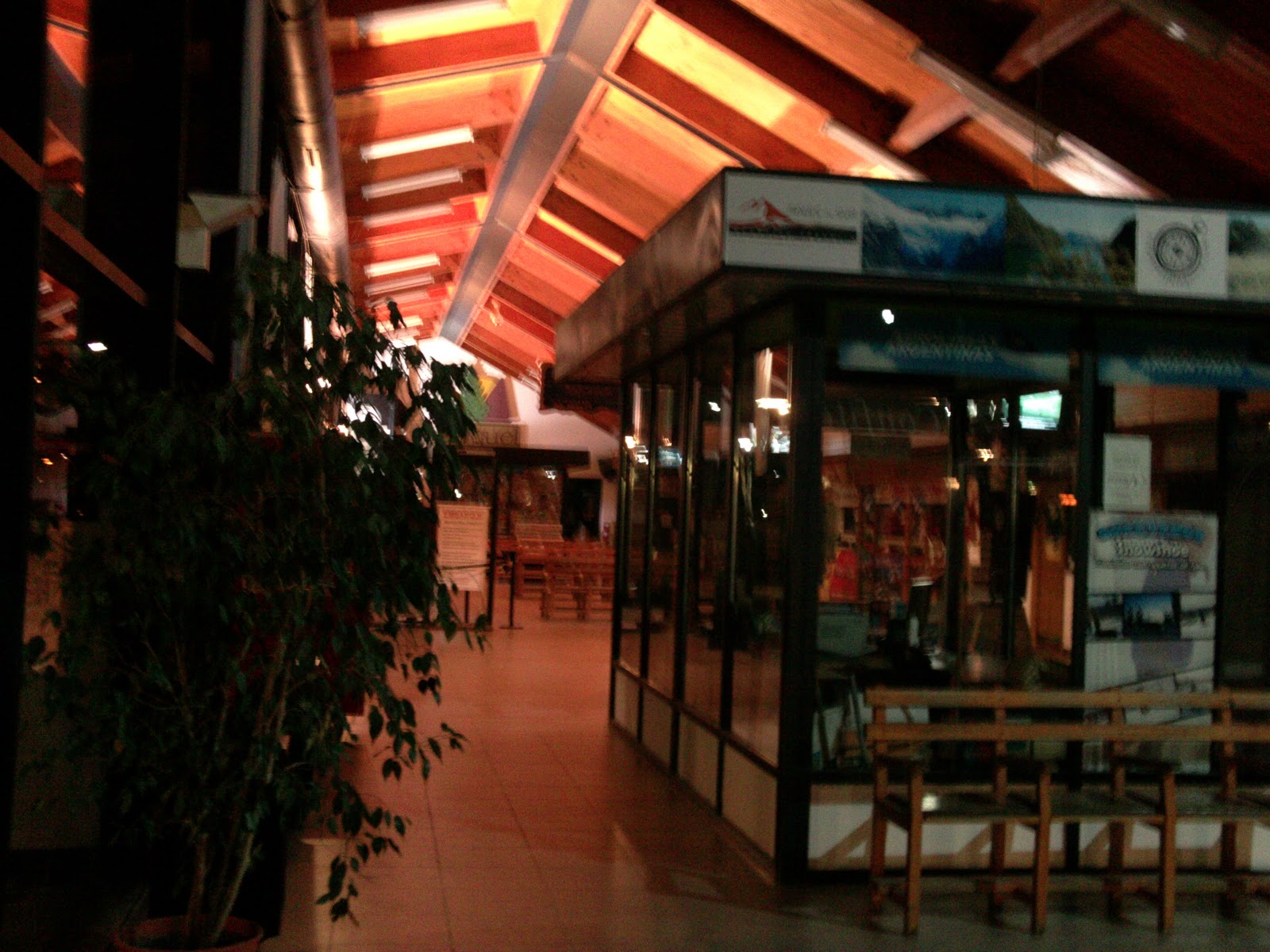 |
| We spent the night under that bench |
All things considered, we made the best of a bad situation, and truth be told, it could have been much, much worse. Although neighboring cities like Bariloche and El Bolson had more going for them touristically, their open air bus stations would have forced us to find hostels for the night. That said, sleeping on the floor of a bus station (even one with a roof and doors) is just another of those romantic, rugged, thrilling backpacker fantasies that gets you some marginal street cred among other travelers. Once you cross it off your bucket list, though, you never really have a desire to repeat it.


 Posts
Posts

