"Women are the guardians of continuity. If the hearth moves, they move with it. Remember, it is the gypsy women who keep their men on the road."

~"Boomerang Love," Jimmy Buffett


Showing posts with label Buenos Aires. Show all posts

Night at the Bus Station: The Battle for Floorspace

When it comes to travel writing and blogging, the focus is almost exclusively dedicated to what you find at the destination. And rightly so – that’s sort of the point of traveling, right? Occasionally, there might be some spotlight on the method of travel itself, such as my last post highlighting some of my more memorable experiences on bussing around the country. What is usually neglected, however, are those interim periods between stops. I mentioned in my last post that I have amassed over 150 hours of bus travel. That figure does not include the countless hours of wait time spent dawdling between stops.

In a perfect world, one would arrive a comfortable 15 minutes prior to their departure time, just enough cushion to check their luggage, buy a snack, and use the bathroom one last time, but not so long that you feel you are wasting time by being early. The bus ride would be uneventful, and upon arrival at the target destination, one could immediately board the next taxi to the destination city’s center and the fantastic travel adventures would commence.  The amount of time spent at the actual bus station would be minimal, a parenthetical that is so fleeting that it doesn’t really dignify acknowledgment. Sadly, that is rarely the case. Whether it was due to mechanical problems, layovers between bus rides, union strikes, or just inexplicable delays, a good, not insignificant chunk of our trip was spent hanging out in bus stations. Although it isn’t particularly glamorous or romantic, considering how much time we have spent in bus stations, I felt it would be remiss to ignore this inevitable aspect of our travels.

You see, when travelling by bus, every small decision can affect your experience: the bus company you select, the time of year, the time of day, and even the seat number. Over the last several months, I like to think that I have become quite savvy at striking that balance between minimizing my travel time, maximizing my comfort, and keeping within my budget. The bus station itself, however, is a factor that you have relatively little control over. In my experience, bus stations have run the gamut from ramshackle benches and dirt floors to full-service centers that rival most outlet shopping malls. Interestingly, although the bus station is technically your first impression of a new location, there is rarely any correlation between the bus station and the actual city. For example, Buenos Aires, for all its glitzy, cosmopolitan glamour, has a bus station that is as skeezy and unattractive as the rest of them. The basement flower felt like the catacombs of Snape’s dungeon, the concrete walls and floors were uninviting and cold, and the open doors allowed for the occasional stray dog or beggar child to wander freely. Meanwhile, random unassuming cities tucked in the middle of nowhere like Neuquen have inexplicably clean, immaculately kept stations that provide a pleasant surprise for travelers who have the privilege of passing through to use their facilities. 

Perhaps the only features accurately represented by the station are the city’s size and popularity among travelers.  To begin, Buenos Aires’ massive tri-level station has an elaborate color-coded system of dividing gates and ticket agents by regional sectors based on the destination. For example, if you were bound for Tucumán, you would head towards the “Northwest Argentina” zone (orange, I believe), which is then subdivided according to different bus companies. This system is further complicated during off-peak hours, when you arrive at your target location, only to find a sign taped to the window directing you to a sister counter in another zone. It’s not unlike arriving at your gate at the airport, only to find that the waiting area for your flight has been moved to the terminal on the other side—the only difference being that none of the bus stations have the handy golf cart drivers, moving floors, or underground shuttle systems that can expedite the commute. About the closest thing I have encountered to that level of technological convenience is that Cordoba, Argentina’s next largest city, has escalators connecting some of its floors (but just some of them). This behemoth station is a four-story monstrosity with a labyrinthine design that does little to facilitate its high traffic. Instead, I found myself in a maddening cycle of crossing bridges, going up and down stairs, following arrows, and essentially finding myself back where I started – it felt like being in a living Escher painting. This mayhem is compounded by the fact that despite its size, there is very little diversity among the sectors. It’s an endless cycle of the exact same cafes and restaurants with the exact same signs, with waiters wearing the exact same uniforms, serving the exact same food. Needless to say, after hours of travelling and sleep deprivation, it is easy to get disoriented.

Cordoba's station is like a less Inception-y version of this 
Meanwhile, on the other side of the spectrum, you have the cities that are too small to justify a central bus terminal. Usually there are only a handful of bus companies that pass through, so they will drop you off directly at their ticketing station. There is rarely a waiting area or information desk (or bathroom!), so you’re on your own as far as finding your way into the city, getting food, finding housing, etc. Some of the routes which primarily serve locals go one step further. Rather than having an actual building which serves as a station, there is just a desultory bench or decrepit little tin structure on the side of the road. Occasionally, I have seen passengers who flag down the bus from places on the highway which are completely unmarked. I have yet to figure out what establishes these locations as actual “stops,” and fortunately, I have never been put in the situation to find out.

El Bolson bus "station" 
As hinted at before, however, due to the freak cold snap that swept through Argentina in July, I was forced to spend my first night at a bus station.  The irony of the story, however, is that we didn’t technically have to sleep there. All the buses for that night were suspended, that fact wasn’t changing. What surprised me, however, was that the bus companies and conductors were generously offering passengers the chance to sleep on the heated bus. Seeing as how the initial plan was to take an overnight bus anyway (not to mention that we were already experts at the fine art of bus-dozing), that offer did not seem like an altogether awful compromise.  It was actually much better than expected, and we had every intention of accepting this plan.
We just wanted to eat dinner first. And again, wonders never cease, the bus companies were providing hot meals for all the passengers who were stranded at the station. Most of the passengers were just eating on the bus, but having just freshly arrived from an earlier bus, we decided to stretch our legs and make ourselves comfortable in the station's restobar. July 19th was el Día de los Amigos (seriously, any excuse for a holiday here), and we thought that our companionship was worth celebrating. Plus, we just really wanted a drink. So we thought a bottle of beer and a little dessert would be a fine accompaniment to our respectable little TV dinner of stir-fried rice.
Our Friendship Dinner
If I had the choice to pick a city in Argentina to be stuck in for the night, Esquel (population 28,000) would not have been at the top of my list. This observation is based on the fact that aside from the casino down the street, the restaurant in the bus station bar may have been one of the more happening places to be. The café was a fairly large room, complete with a projector screen, audio equipment, tacky Christmas lights, and a chalkboard that promised live music on Thursdays (alas it was a Monday). Nevertheless, the atmosphere was much upbeat than your average bus station, and infinitely better than being stuck in a bus full of sleeping babies. Initially, the plan was to strategically exhaust ourselves in order to pass out on the bus. It was working splendidly - we were laughing and enjoying eachother’s company, we were well-fed and in high-spirits, plus we had the luxury of using a normal-sized bathroom whenever we wanted. At about 2:30 AM we finally decide to turn in for the night and head to our bus. It was then that realized that we had been locked out. What we hadn’t considered was that it was only the passengers who would be sleeping on the bus-- not the drivers. Miscalculation. The other passengers couldn’t have let us in if they wanted to. With no other options, we headed back to the station, picked a spot away from the windows, spread our blanket on the floor, put on as many layers as possible, secured our backpacks to a nearby bench,  and lay down for some fitful, chilly sleep. 
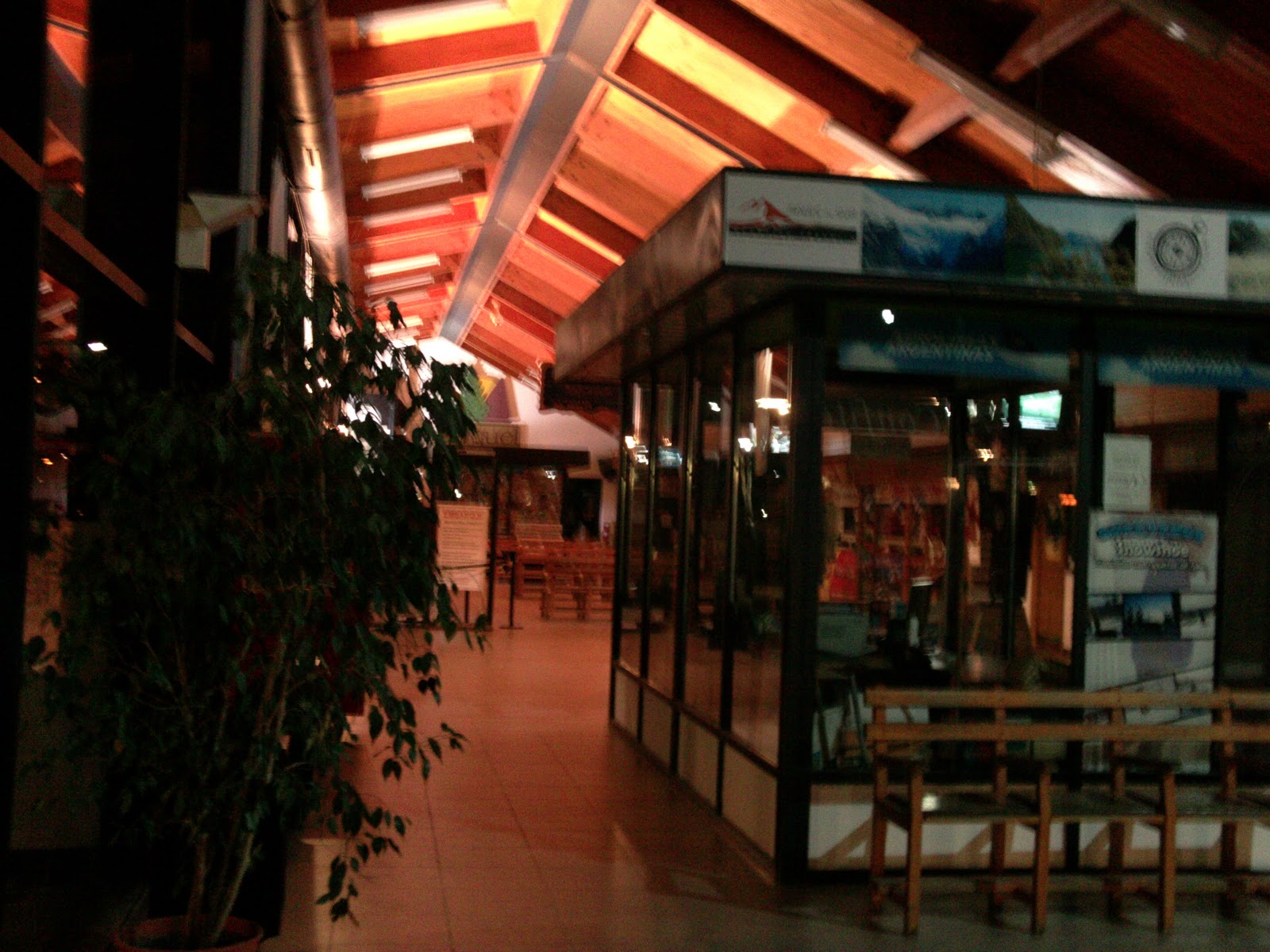
We spent the night under that bench
All things considered, we made the best of a bad situation, and truth be told, it could have been much, much worse. Although neighboring cities like Bariloche and El Bolson had more going for them touristically, their open air bus stations would have forced us to find hostels for the night. That said, sleeping on the floor of a bus station (even one with a roof and doors) is just another of those romantic, rugged, thrilling backpacker fantasies that gets you some marginal street cred among other travelers. Once you cross it off your bucket list, though, you never really have a desire to repeat it. 

World Cup 2010: Vamos, Vamos, Argentina!

On the 3-hour return flight from Ushuaia, LAN airlines made the genius, inspired decision to show a game-by-game recap of the 2010 World Cup finals. Eager for a distraction from the little girl who would not stop kicking the back of my chair, I plugged in my headphones to watch. To my amusement, it was a British sportscaster narrating the game recaps. It was delightful to hear his Anglophile renditions of names like “Xavi,” “Forlan,” and “Kaka.” To my horror, with each passing moment, I came to realize how fully I had invested myself into this sporting event. For starters, I had somehow found the time to watch every game in the knockout stage. Moreover, I hadn’t just watched them. I followed them. Religiously. I recognized the names of the star players (usually the “strikers”). Every night, I would faithfully log on to ESPN to filled out the results in my little bracket chart. From the highlight reel, I was able to relive some of the emotional highs and lows: My heart swelled with pride when Donovan scored the last minute go-ahead goal to push Team USA into the finals. It broke for Ghana’s overtime loss to Uruguay. I cringed as I was forced to re-watch Germany’s systematic disassembly of my beloved Argentina. And in the dramatic finale, when the camera zoomed in on Iker Casillas, the Spanish captain and goalie, weeping for joy at his country’s first title, I found myself shedding a tear for them as well.

It seems like only yesterday that in anticipation for this grant, I was asking my friends for a crash course on the rules of the game. The concept of “offsides” was particularly difficult to grasp. I remember being at a restaurant with Koci, who was moving salt shakers and napkin holders around the table. With Zack, we were at a tattoo parlor, so the only props available were his hands. Although their valiant efforts were unsuccessful, it all turned out to be unnecessary. As it turns out, I just needed to watch a couple actual soccer games. Once the Mundial started, it all clicked. By the end of the qualifying rounds, my Facebook status was dominated by shout-outs to Palermo and Maradona. Selene and I were fluently dissecting the different styles of play: Team Argentina’s flashy offense, Germany’s chilling scoring-efficiency, Spain’s intricate European formations, Team USA's clumsy ball-handling, Holland... just kind of being there. One of my prouder moments was maintaining a respectable conversation with a middle-aged Argentine banker regarding the differences between the European and Latin leagues. It is for all these reasons that I am convinced that the World Cup remains the single-most international sporting event, even surpassing the Olympic Games.

For example, I have found K'naan's stupidly catchy “Wavin’ Flag” song far more effective at rallying a crowd than any of Bono’s or Will.i.am’s UNICEF/Save the children/USO super-medleys. Just last week, the kickboxing instructor at our gym made us do about 30 lunges to this tune. I don't care how cheesy it is- even now, 3 months after the start of the tournament, the opening “Ooh-oh-oh-oh” riff still gets my blood pumping. There are several versions recorded to appeal to the various regional demographics (for a fascinating examination of Middle Eastern culture, check out the Arabic version featuring Nancy Ajram), but naturally I am partial to the Spanish version featuring David Bisbal:


One of my favorite memories of this season (and possibly my entire stay in Argentina) was the Argentina vs. South Korea game on June 17. Purely by chance, this game fell on the week of the Fulbright midterm conference, and we all found ourselves back in Buenos Aires. It was a double whammy-- not only was I reunited with my fellow ETAs, but we also had the unique opportunity to watch a World Cup game in the capital city. It was sure to be a memorable experience, possibly the only thing that would have roused some of us up before 8 AM. Meeting in the lobby, we were decked out in our various iterations of celeste and white: silly hats, bootlegged black market imitation jerseys, one particularly enthusiastic individual had draped himself in the Argentine flag.

Gringos united
We were headed to the Plaza San Martin in the heart of Retiro, one of Buenos Aires’ largest and most centrally-located districts. The expansive park features a sprawling, sloping lawn, perfect for an outdoor showing. Cold and still bleary-eyed from shenanigans the night before, we shuffled in silence. The streets around our hotel were fairly empty, or at least only just beginning to wake up. As we neared the plaza, however, the undeniable buzz of a gathering crowd became palpable. Our pace quickened as we followed the electric hum of people convening from all directions. Street vendors with horns, flags, and other miscellaneous memorabilia were beginning to pop up with increasing frequency. We started to see more wires and cords, eventually leading to A/V equipment. And finally, we saw the huge screen and knew we were in the right place.


Our party situated itself near an enthusiastic-looking group (per K'naan's instructions, there were lots of flags waving) - close enough to get a great view of the action, but safely out of reach from potential mosh pits up front. It turned out to be a good decision, since hidden amongst our neighbors was a little impromptu band featuring a drummer and an indefatigable trumpet player whose tunes kept us hopping and clapping the entire game.

And what a game it was. With each Argentine goal (there were 4… it was kind of a slaughter), the crowd reaction grew increasingly raucous and rowdy. By the third goal, we were hugging, screaming, and twirling our shirts over our head. Confetti was raining, and those horribly obnoxious horns that sounded like dying elephants were blaring non-stop. By the end of the game, our throats were hoarse from cheering, our feet were tired from jumping, and our shoulders were sore from waving our arms. It’s one of the best feelings in the world. It’s like that adrenaline high that you feel after leaving a rock concert or a really badass nightclub. Everything is little muted because your ears are ringing, but you really don’t care because you’re in such a giddy mood. Nobody’s really talking to eachother, but there’s a little skip in everybody’s step as you’re walking back home (or in this case the hotel). Even in typing this entry, I am just hit by a wave of nostalgia for Texas football games at Darrell K. Royal Stadium… the Godzilla-tron, the incessant drum cadences, surprise appearances by Matthew McConaughey, and those coupons for 5 free wings at Plucker’s every time the Longhorns won. As stoked as I am about football, however, my first experience following the World Cup has finally converted me into a soccer fan. Although I’m unlikely to follow the regular season with any consistency, I will probably find myself falling in love all over again in four years. That is, if I’m not actually in Brazil.

In the meantime, a personal note to Coach Brown: How about ordering 100,000 vuvuzelas for DKR? Combined with “Texas, Fight!” our defense would be unstoppable. And we would still be less obnoxious than Red Raiders fans…

Dinosaur suit = best. costume. ever


Giant bouncy ball


Argentine flag wavin'. Caution: NOISY

Dance, Dance: How I Got My Groove Back

I have always thought that Sebastian was a good-looking guy. He always dressed and carried himself in a way that implied that he knew how to take care of himself. He was a student in my fifth year class, which had invited me and my roommate (a fellow gringa) to an Argentine asado, or barbeque. After stuffing ourselves with inordinate amounts of grilled meat, most of us were listening to music as we recuperated from a food coma. I remember leaning back in my chair and watching Sebastian dance with a female student. In one of his hands, he was simultaneously cradling a lit cigarette and a plastic cup of Fernet and Coke. With his other hand, he was skillfully spinning his partner. All the while, his feet were marking time to the rhythm of the music. For lack of a better word, he looked damn cool.

Even a couple months after the fact, this particular image is burned into my memory because it was at that exact moment that I thought, “This isn’t fair.” At this point, I had spent enough time with my students to determine that this confluence of desirable traits was not unique to Sebastian. In all of our social gatherings, after a couple hours of food and/or alcohol, the festivities would inexorably devolve into an extended karaoke dance party like this one.

Our first party in the Office

During this time, students would flaunt their skills and knowledge in a variety of musical styles, such as cumbia, salsa, quartetto, and reggaeton. These “lessons” regularly last into the early hours of the morning. It seemed that every Argentinean was born with a genetic predisposition for singing on pitch, dancing with coordination, and being ridiculously attractive. This holy trifecta defies both probability and fairness, considering how hard we had to rack our brains to share a reciprocal “traditional American dance.” Against our better judgment, we halfheartedly demonstrated the old wedding standby, the Electric Slide.

Once the shame of linedancing to “Achy Breaky Heart” wore off, I started pondering the roots of the prevalent “gringo with no rhythm” stereotype, and I set out on a mission to surpass it. I made some headway after attending a lecture on Argentine music with professor Dr. Juan Raffo, who utilized a variety of techniques to demonstrate the complicated rhythms in folklore music. We learned that many of these musical styles borrowed heavily from tribal African drumbeats. The cadence of these beats was in direct opposition to our classical sensibilities of Western music, which tend to place emphasis on the downbeat, or the “one” of each phrase. We had become so accustomed to this regimented style, that any deviation felt unnatural or awkward, explaining our inability to synchronize with certain rhythms.

With this newfound musical revelation in tow, I tackled the next matter of acquiring actual dancing skills by enrolling in a bi-weekly salsa class at a nearby dance academy. Each class was structured the same way. At approximately 10:33 PM, our instructor, another well-dressed, good-looking man who knew how to dance, would lead us in a vigorous warm-up that included a laughable quantity of hip rolls and pelvic thrusts. Next, he would break down the target moves for the night, and we would drill them together. At the midway point, we would switch to practicing the new steps with partners. Since salsa is a couple’s dance, you would think that we would look forward to the opportunity to work in pairs. The only hitch: the number of female students outnumbered the males in a whopping 4:1 ratio. As such, the women were asked to line-up in a pattern reminiscent of an amusement park line in order to await their “turn.” Those lucky enough to end up with a partner would typically find themselves facing a self-conscious, sweaty-palmed young man unequipped for the pressure of physically engaging a conveyor belt of women. Out of principle, my inner feminist couldn’t handle it. After a month of classes, I decided to move on.

Being in Argentina, the only natural choice was tango. To get the full experience, I plunged into the heart of the beast: Buenos Aires. In this cosmopolitan metropolis, there are guidebooks and brochures dealing exclusively with milongas, dedicated tango halls. I signed-up for a class in the ritzy Palermo district, receiving the full “tourist” package: a tango demonstration, a formal class, and finally free dance. After a few minutes of audience banter involving a soccer ball and some attractive, well-dressed Argentine women who were likely very good dancers, the emcee finally introduced the 4 couples who would also be our teachers that evening. The lights around the dance floor dimmed, and the speakers were filled with the plaintive strains of bandoneon and violin. The couples marched effortlessly across the floor, their bodies aligned and in sync. In watching their movements, the rigid postures and complicated footwork seemed to follow very strict conventions of steps and form. Once we started actually practicing, however, we discovered that there was much less emphasis on actual choreography as much as spontaneous reaction to the music and your partner. A memorable “teachable moment” involved a partner with whom I initially had difficulties following. After several clumsy missteps, he told me to close my eyes. I obliged. In the absence of sight, I became acutely aware of the floor at my feet, my physical proximity to other couples, the stringed instruments in the music, even the scent of my partner’s cologne. Without any visual cues, my only choice was to move instinctively, and it was surprising how naturally I followed him. This incredibly visceral experience helped me appreciate the reactive, intuitive, and literal sensuality of the dance.

Obviously, a 45-minute tango lesson is not sufficient to overturn the “Americans can’t dance” stereotype. A month of salsa classes was also inadequate, as we painfully discovered the first time we wandered into a salsa bar. As we tried to maneuver our way through the sea of gyrating couples, we were repeatedly buffeted by an array of people spinning and turning in seemingly unpredictable directions. I was beginning to think my undertaking was a hopeless cause, but I decided to throw one last desperate Hail Mary. With nothing left to lose, I decided to show off my moves at a boliche, an Argentine disco. Although my experience with these dance halls is woefully limited, I have noticed a few universal commonalities: an over reliance on Matrix style lasers and fog machines; a large projector screen showing music videos; and a surly DJ who runs the playlist with dour stoicism. Each boliche has its own special gimmicks (a ceiling of disco balls, glow-in-the-dark ice cubes, etc), but it all reduces to the same thing: a big sweaty dance party. And if there is one dance move that Americans can claim as their own, it would be the club grind. There are no genre-specific steps nor does it require any formal training. Essentially, it involves bopping your head, swinging your hips, and moving your extremities in some semblance of rhythm. Depending on the song, it may also be acceptable to jump up and down in a steady bounce.
Can this even be correctly categorized as "dancing"?

In accordance with our gringo sensibilities of club dancing, my roommate and I started flailing and thrashing our limbs in reckless abandon. If an opportune hole opened up amid the mass of humanity, we would creep into it like auspicious Walmart shareholders, shaking our heads and waving our arms the whole way. Admittedly, there were occasions when we would lose control of our hopping and accidentally bump into our neighbors. Nevertheless, these incidents usually occurred during Lady Gaga songs, which provides full amnesty for your behavior within the duration of the song. After a particularly raucous rendition of “Bad Romance,” I made eye contact with yet another well-dressed, good-looking Argentine man who seemed to know how to dance. He leaned his face towards mine, and yelled something into my ear, but it was unintelligible over the thundering bass. After a few more tries, I was finally able to piece together “Bailas muy bien” (You dance very well). I grinned in understanding, and he raised his glass to me before returning to his respective party. At that moment, I was breathing heavily, sweating profusely, and feeling immensely satisfied with myself. Mission accomplished.

Just dance, gonna be okay, d-d-d-dance